


Introduction — Defining the Core Problem
Commercial pergola OEMs confront a singular problem: how to translate architect-led concepts that combine shading, weather protection, and power generation into reliable, scalable products. Design intentions for a photovoltaic pergola often collide with manufacturing realities—structural load, water drainage, electrical integration, and supply-chain variability—creating cost overruns and field failures when not reconciled early. This text diagnoses the principal failure modes and proposes practical controls for a predictable translation from concept to production.
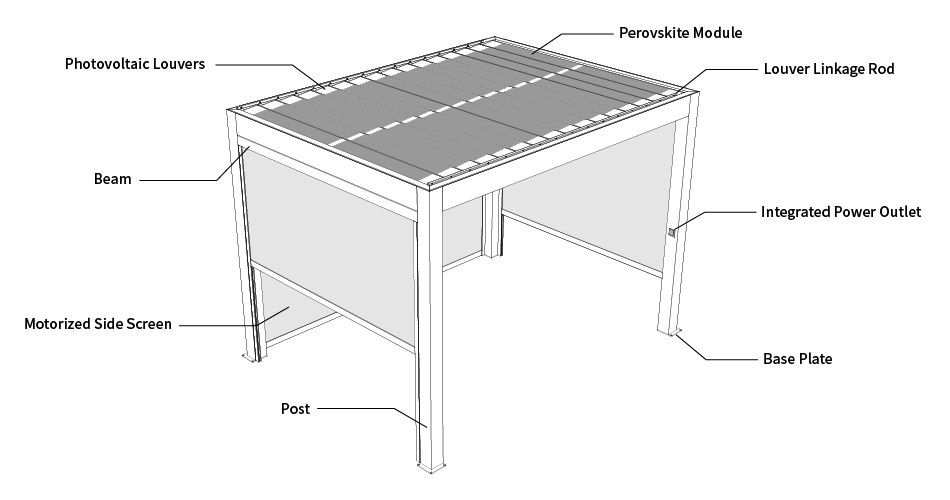
Primary Technical Challenges
First, structural adequacy is non-negotiable. Pergola spans and motorized louver systems must be designed for local wind and snow loads per relevant standards (for example, Eurocode or ASCE 7). Second, the junction of photovoltaic modules and moving louvers introduces mechanical, electrical, and thermal interactions that complicate sealing and serviceability. Third, control electronics for louver actuation and solar optimization increase points of failure and require robust ingress protection and EMC mitigation. Addressing these issues early reduces iterative rework downstream.
Design Choices That Matter
Material selection dictates longevity: powder-coated aluminum extrusions resist corrosion and reduce weight, stainless or marine-grade fasteners reduce galvanic risk, and polymeric gaskets with proven UV resistance preserve sealing. Louver geometry influences both rain-shedding and PV mounting; flat louvers simplify PV lamination but impede drainage, whereas angled louvers shed water better but demand bespoke PV attachments. Design for maintainability—accessible motors and replaceable seals—lowers lifetime service costs.
Control Systems and Electrical Integration
Control architecture should separate safety-critical elements (wind stow, rain closure) from energy-optimization routines. Redundant sensors for wind speed and precipitation reduce false positives. Electrical routing must isolate low-voltage PV wiring from actuator power to limit interference and simplify troubleshooting. Specify IP65 or higher enclosures for control modules and require surge protection to protect PV inverters and control electronics against transient events.

Manufacturing Process and Quality Assurance
Standardize extrusion profiles and component interfaces to permit modular assembly and reduce machining variability. Implement statistical process control for critical dimensions and weld quality. Fixture-based assembly reduces human error during alignment of louvers and PV panels. Full-system environmental testing—cycling for ingress, thermal expansion, and actuator endurance—should be performed on pre-production units to validate life-cycle assumptions before tooling is locked.
Common Pitfalls and How to Avoid Them
Designers frequently underestimate dynamic loads from motorized movement; undersized actuators lead to rapid wear. Overreliance on proprietary fasteners or bespoke parts creates supply-chain fragility. Sealing is commonly treated as an afterthought; inadequate gasket compression and drainage planning produce persistent leaks. Mitigations are concrete: calculate dynamic service factors for actuators, prefer standardized components with dual-source suppliers, and design continuous drainage paths that cannot be obstructed during installation.
Evidence of Experience and Authority
Manufacturer credibility arises from demonstrable field performance and alignment with recognized practice. Field trials in Southern California provide a relevant high-exposure dataset for solar-integrated shading systems, where UV, wind, and fire-risk considerations are documented by regional building studies. My team’s installations in that region informed the specification of louvers and control logic used here; they highlighted the necessity for robust sealing and for motorized response to sudden wind events. For practitioners evaluating alternative approaches, a motorized louvered pergola exhibited measurable reductions in water ingress incidents compared with early prototype systems, reinforcing the need for integrated mechanical-electrical design and pre-deployment endurance testing.
Decision Framework and Implementation Roadmap
Adopt a phased development sequence: requirements capture → interface definition → modular prototyping → environmental verification → pilot production → scaled manufacture. At each phase, employ risk registers tied to testable acceptance criteria (structural deflection, actuator cycles to failure, ingress rating). Use design freeze gates to prevent scope creep after tooling investment. When choosing suppliers, require sample validation and a documented corrective-action history rather than relying solely on cost or lead time.
Conclusion — Practical Resolution and Value
A problem-focused approach reduces time-to-reliable-product by aligning engineering, manufacturing, and field feedback from the outset. Concrete measures—standardized profiles, modular electronics, validated sealing strategies, and staged verification—turn conceptual pergola systems with integrated photovoltaics into repeatable OEM production. The outcome is not abstract improvement but a tangible reduction in field failure modes and lifecycle costs, a result routinely achieved by manufacturers who partner with system integrators such as Light Hunter to harmonize design intent and production discipline.
