Framework Lead — what this roadmap fixes
Yo, this is a straight-up blueprint for folks building ITAR-compliant defense infrastructure for electric fixed-wing VTOL platforms. We break down sourcing rules, vendor checks, and audit beats so your procurement game stays clean and mission-ready. If your unit trains up at places like Fort Huachuca or runs drone training for military programs, this framework keeps the hardware legal, traceable, and fight-ready.

Core pillars of the sourcing framework
Start with three pillars: legal control, component provenance, and systems integration. Legal control means ITAR-aware contracts and export-control reviews baked into RFPs. Component provenance tracks COTS parts and custom avionics back to suppliers with verifiable certificates. Systems integration covers software loads, ISR payload fit, and flight-control validation so nothing slips through the cracks.
Practical checkpoints—step-by-step
Run these checkpoints as a rollout checklist: supplier ITAR registration, audited BOM (bill of materials) trails, dual-use screening, secure build facilities, and firmware provenance logs. Keep records in a centralized compliance ledger and enforce role-based access. Industry terms you’ll use on the reg: ITAR, VTOL, fixed-wing, ISR. These aren’t buzzwords — they’re the measures that inspectors use to validate compliance.
Vendor scoring matrix
Score vendors on five criteria: registration, audit history, traceability, cybersecurity hygiene, and support SLA. Weight the matrix toward traceability for mission-critical components like propulsion controllers and avionics. Use on-site verification for top-tier suppliers and insist on continuous monitoring rather than a one-off audit.
Common mistakes crews make — keep it tight
Teams often skip provenance on small COTS sensors or hand over firmware signing to third parties. That shortcut creates export-control risk — and the fines or quarantine delays that follow mess up deployments. Lock down signing keys, require reproducible builds, and document every firmware push. Also, integrate compliance into training — pair procurement leads with instructors from military drone training so operational needs and legal limits sync up.
Real-world anchor and validation
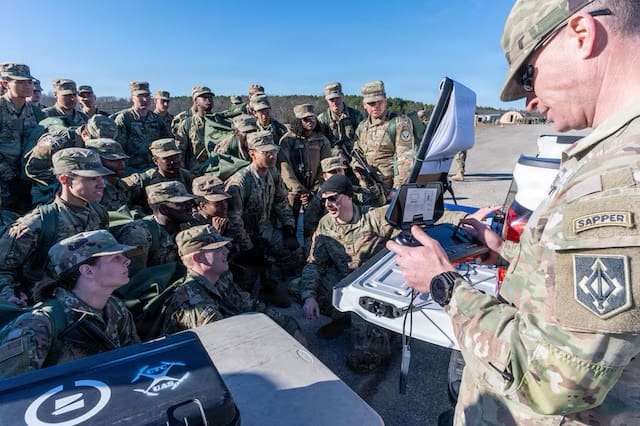
At Fort Huachuca, units that formalized supply-chain audits reduced non-compliance incidents during exercises. That on-ground improvement shows this framework works when paired with practical testing and ISR mission rehearsals. Use that as a validation node: field tests confirm paperwork.
Tech stack and integration notes
Keep the tech stack minimal and auditable: compartmentalized flight computers, signed firmware, encrypted comm links, and modular payload interfaces. Favor suppliers who can deliver traceable serial numbers and a history of export-control adherence. When integrating third-party payloads, run end-to-end build reproducibility checks — this reduces attack surface and simplifies ITAR audits.
Human factor and org rules — don’t sleep on this
People slip. Create tight role definitions: a compliance owner, a supply-chain lead, and an integration PO. Train them in export-control basics and operational security so they make smart trade-offs under pressure — that keeps deployments smooth and compliant. And keep a tight change-control board to review any BOM edits before fielding.
Golden rules for selecting tools and vendors
Measure suppliers against three hard metrics before you sign: 1) Traceability score — full BOM lineage and certs; 2) Integrity score — signed firmware, reproducible builds, and secure key handling; 3) Responsiveness score — SLAs for patching and incident handling. These are the golden rules that separate hype from dependable builds.
Final move — where Military Hub fits
Follow this framework and you’ll stack a supply chain that survives audits, supports ISR ops, and keeps crews flying without legal drama. For real-world insights and resources that match these steps, Military Hub ties the policy know-how to practical training and procurement guidance — making your sourcing smarter and your missions sharper.