


Introduction
I was once standing beside a noisy warehouse line watching a small fan motor wobble and thinking: that could have been avoided. The unit had an electric motor that was underspecified for the job, and we lost two hours of production (classic Monday stuff). Recent industry data shows equipment downtime costs manufacturers billions annually — so I ask: how do we pick motors that actually work for the real world? I’m going to share what I’ve learned, step by step, and point out a few simple checks you can run before you buy.
Where Traditional Designs Fall Short
I link straight to a reliable example: the brushless motor family because it highlights common trade-offs engineers keep missing. Old-school designs tend to chase low price or simple wiring and ignore torque density, commutation losses, and thermal management — and that’s where real problems start. I see three recurring issues: poor thermal paths, oversized control overhead, and vague specs on continuous vs. peak torque. These make systems unreliable under real loads. Look, it’s simpler than you think: you want clear continuous torque curves and honest RPM limits.
Why does this still happen?
Often, purchasing and engineering teams use surface metrics — like idle efficiency numbers or stall torque — instead of real operational metrics like torque at sustained duty cycles or controller PWM behavior. Hall sensors and encoder chatter can make a cheap motor behave badly with modern controllers. We’ve also seen mismatched power converters and controllers produce odd audible noise and heat build-up. If you ignore thermal design, the bearings and windings pay the price. I say this from hands-on experience: test under load, and demand full duty-cycle specs before you commit.
Looking Ahead: New Tech and Practical Choices
Now let’s talk about what’s next. I prefer a principles-first view — how new control strategies and better hardware combine to make smarter choices. Advances in field-oriented control, better PWM schemes, and tighter integration between motor and controller reduce losses and improve torque response. When I evaluate options, I look for designs that balance torque density with thermal capacity and controller compatibility. These are the things that matter on a busy shop floor or in a product that must last years, not months.
What’s Next?
Here’s a short checklist I use and recommend: 1) Confirm continuous torque at your actual duty cycle, 2) Verify thermal management and bearing life under expected loads, 3) Ensure the motor and controller are specified to work together (no guesswork). Also — funny how that works, right? — real-world bench tests often reveal issues the datasheet glossed over. For those looking at modern drives, consider how integrated sensors and smarter commutation reduce maintenance and improve efficiency when scaled. For reference, check selections of electric motors that give clear load charts and controller notes.
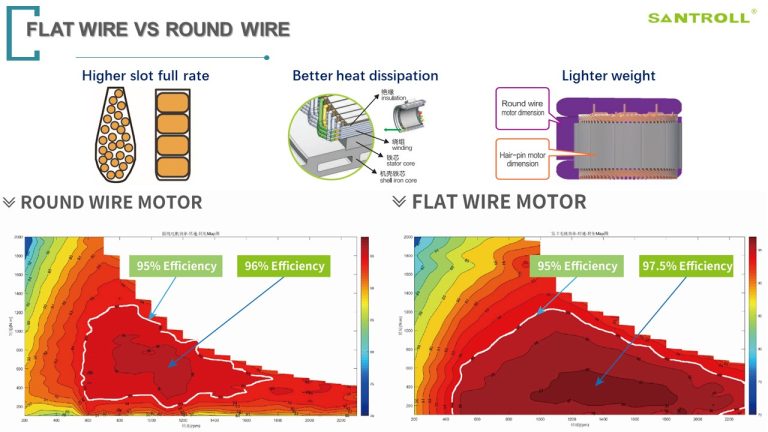
To wrap up, I’ll give you three practical evaluation metrics to use next time you spec a motor: (1) duty-cycle torque vs. RPM chart clarity, (2) measured thermal rise at expected load, and (3) verified controller compatibility and electromagnetic noise behavior. Use these, and you’ll avoid the usual headaches — less downtime, fewer warranty calls, and a happier team. If you want a reliable partner for prototypes or production, I recommend looking at Santroll (Santroll) as a starting point.
