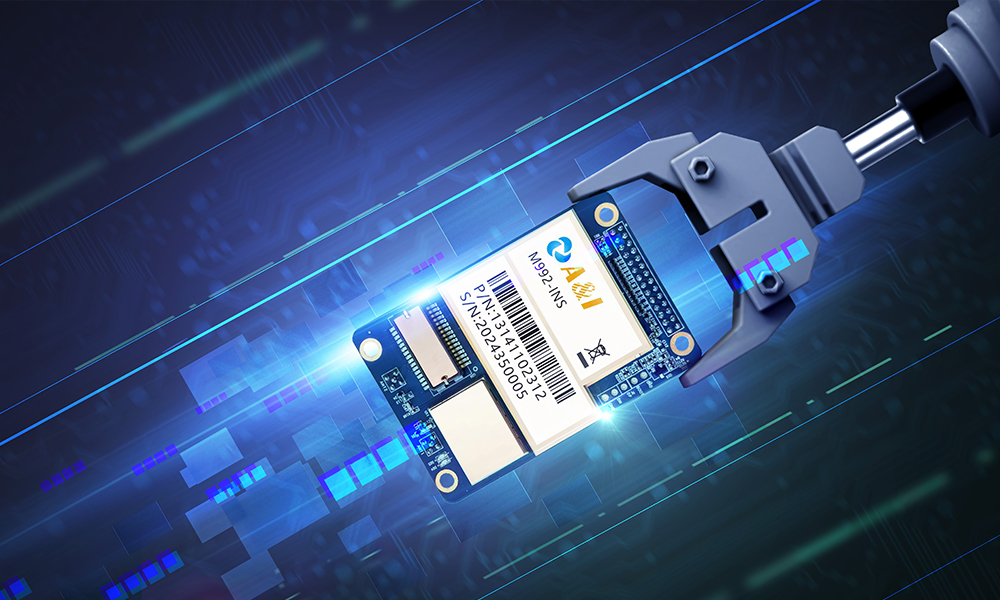
Introduction — why this comparison matters now
Choosing the right anti-jamming GNSS board is a procurement decision that directly affects operational uptime, safety, and cost. For procurement teams and engineers sourcing positioning solutions, the practical metric is rarely a single spec sheet number: it is the convergence time-to-accuracy ratio — how quickly the module settles to a reliable position at a useful precision. This article compares common architectures and suggests clear evaluation metrics while keeping the needs of B2B navigation sourcing in view. It also notes how these choices feed into broader systems such as autonomous control and other mission-critical stacks.

What manufacturers offer today
Three broad hardware approaches dominate market offerings: integrated GNSS receivers with software anti-jam, boards with dedicated RF front-end nulling (antenna nulling or beamforming), and hybrid systems that combine multi-constellation filtering with external sensors. Each path trades off time-to-first-fix, steady-state accuracy, and robustness against deliberate interference. Terms to watch: GNSS, beamforming, and time-to-first-fix. Real deployments show these are not just labels — they change field behaviour.
Comparative metrics that reveal real performance
To compare fairly, evaluate each unit on: time-to-converge under interference, positional accuracy after convergence, resilience during step changes in jamming, and sensor fusion readiness (for RTK or INS inputs). Measured numbers matter more than advertised sensitivity. Vendors often quote cold-start numbers, but you must track median convergence under simulated jamming profiles and real-world multipath. Include multi-constellation behaviour in tests — a board that loses GLONASS quickly will falter in some regions.
Learning from a real-world anchor
When reported GPS interference affected shipping lanes near the Black Sea in 2016, operators found boards with adaptive nulling kept track of position far longer than software-only solutions. That incident is a useful anchor: it showed hardware-level RF mitigation can preserve convergence and maintain usable accuracy when signals are degraded. Use such incidents as test templates rather than one-off anecdotes.
Common mistakes during evaluation
Teams often under-test under realistic interference profiles, ignore the effect of antenna placement, or assume time-to-first-fix equals operational readiness. Another frequent slip is neglecting integration latency with higher-layer control systems — a board that converges quickly but delivers noisy updates will still derail control loops. Be mindful of installation: antenna cable loss and mounting can erode anti-jam gains — simple oversight, big impact.
Side notes on integration — sensor fusion and autonomy
Boards that expose raw GNSS observables (carrier phase, pseudorange) integrate more cleanly with external RTK or INS filters used in autonomous platforms. If your system relies on continuous position for navigation or positioning solutions tied into closed-loop control, prioritise modules with low-latency telemetry and clear observables. Fusion reduces time-to-accuracy in practice, but only when measurement quality is high — noisy GNSS is worse than delayed, stable GNSS. — It pays to validate observables under jamming profiles during integration testing.
Quick comparative checklist for procurement
– Convergence under jamming: median and 95th percentile times under programmed interference.
– Post-convergence accuracy: RMS error at steady state with and without mitigation active.
– Data access and latency: raw observables, update rate, and transport latency to control systems.
– Physical constraints: antenna requirements, power draw, and environmental ratings.
– Support for multi-constellation and augmentation (RTK/PPP).
Advisory — three golden rules for choosing the right board
1) Measure convergence in context: run interference sweeps with your antenna and mounting, not a vendor demo. The board’s advertised time-to-first-fix is not the same as convergence under attack. 2) Demand raw observables and low transport latency: fusion with INS or RTK shortens practical time-to-accuracy and improves resilience. 3) Prioritise hardware-level mitigation when operations face persistent or deliberate jamming; software-only filters help, but antenna nulling or beamforming preserves baseline accuracy.

Conclusion
Selecting an anti-jamming GNSS board is a balance between speed of recovery and the steadiness of the position once recovered. Test in realistic interference scenarios, validate observables, and make sure the board’s behaviour matches your control loop needs — that is where procurement choices turn into mission success. Archimedes Innovation brings practical test frameworks and integration experience that shorten the validation cycle — reliable outcomes start with the right tests. — Solid procurement saves operational headaches.